There is a gap between an app that works on your laptop and an app your friends can use, and an entire industry lives in it. A build pipeline, a host, a bill, a URL that strangers can reach. But the app already runs, and your friends are already people you trust. What is missing is transport and naming. That is the whole of Gruve.
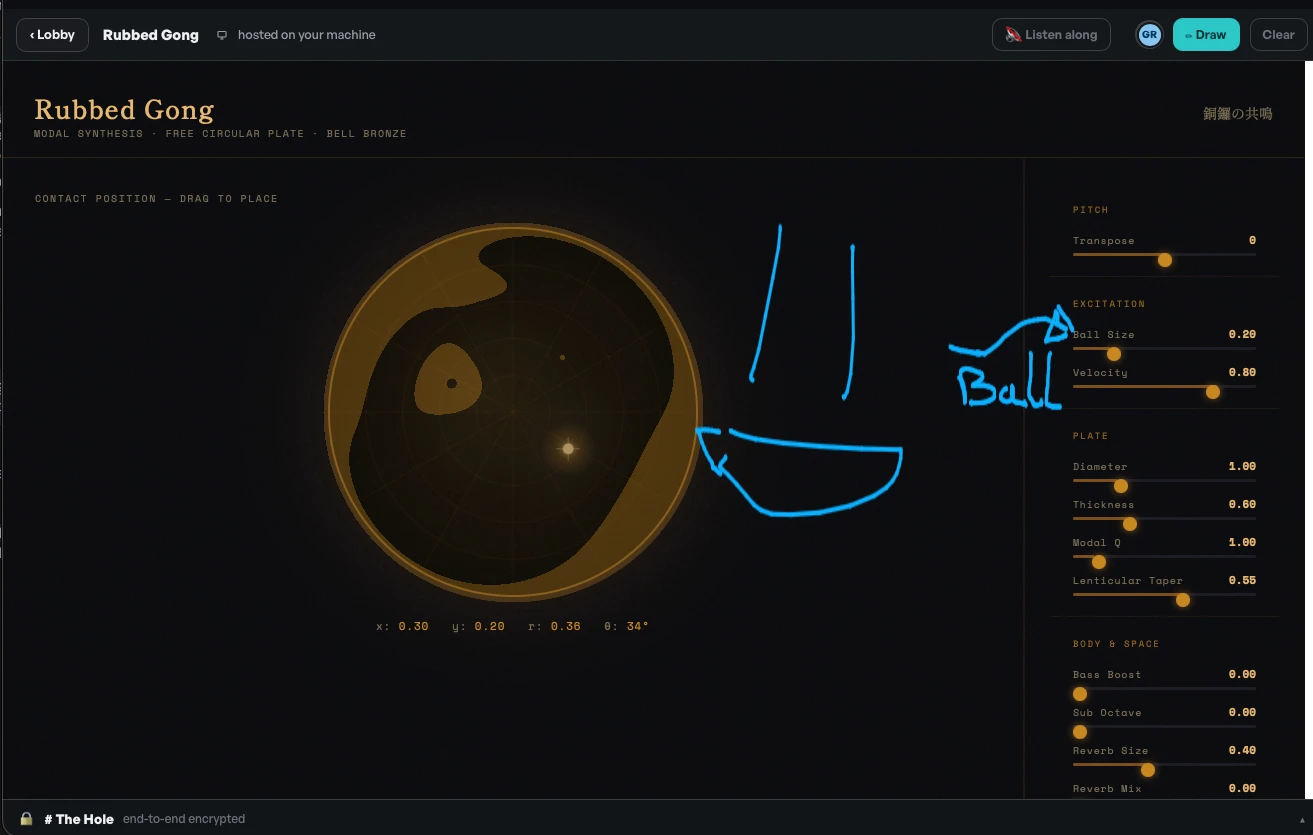
Install one app. Your machine and whatever is running on it appear on a board your friends see, and theirs on yours. Click a tile and someone else's project opens in your window, served from their laptop over a direct encrypted connection, with cursors, a whiteboard, and a row of faces on top. Nobody deployed anything. There is no account, and there is no downtime unless someone trips over a power cable.
The kit is the other half: four SDKs, in JavaScript, Rust, Python and Go, three of them with no dependencies at all, and the contract they implement. An app becomes mesh-ready with one POST to its local agent and a heartbeat. From then on it is reached by name, never by address. /apps/gong/ is the gong wherever the gong is. /svc/tts is whoever in the net can do text to speech, yourself first.
2026.08.22 — ONE FILE
v0.3.0. A terminal UI for headless boxes, and a single binary: the Rust mesh daemon is packed inside the Go agent and unpacks itself, content-addressed, on first run. Copy it to a server and the server is a node.
2026.07.14 — EVERY POCKET
v0.2.0, all platforms. A phone cannot spawn a child process, so the daemon is compiled to a static library and linked into the agent: one native binary with both inside, and the same start signature over a spawn on the desktop and a foreign call on iOS and Android. The phones went from hiding hosting to consuming it. Shared ports and files, from a pocket.
2026.06.30 — SIGNED
v0.1.8, the first notarized macOS build, two days after the in-app updater. A webview running yesterday's lobby is how phantom bugs come back from the dead, so the lobby does not cache.
2026.06.17 — THE CONTRACT
The SDKs split out into their own public repo, with a Python and a Go port the same day. They ship with a document of rules for apps that want to live on the mesh, and each rule exists because breaking it produced a real debugging night. Rule six was born from a haunted play button, clicked a hundred times a second by a sync loop, and a stereo echo. Also that day, apps moved to their own origin, so a hostile app cannot reach the lobby's API, delete a network, or read a chat key.
2026.06.16 — RIP OUT THE CONTROL SERVER
The first version enrolled every node into a Headscale control plane over Tailscale. It worked, and it was a server. A spike on the fourteenth proved that membership could ride iroh-gossip with no server at all. By the sixteenth Headscale, tsnet, and the self-hosting module were gone. A network is now a gossip topic. Every node says its name and its address every three seconds and forgets anyone silent for twelve. Discovery resolves an ed25519 key to wherever that key is right now, and QUIC punches the hole. Two laptops on two continents behind two NATs connect the same way as two on a couch.
Two bugs from that week are written into the daemon as comments. Plumtree demotes quiet links to lazy pushes, which starves a mesh of two, so broadcasts go to neighbours directly. And a network's creator, subscribed with nobody to talk to, never promoted a late joiner into its eager view and saw a roster the joiner did not. So every node re-dials everyone it has ever seen, every thirty seconds, forever, even when healthy.
2026.06.11 — THE CABLE
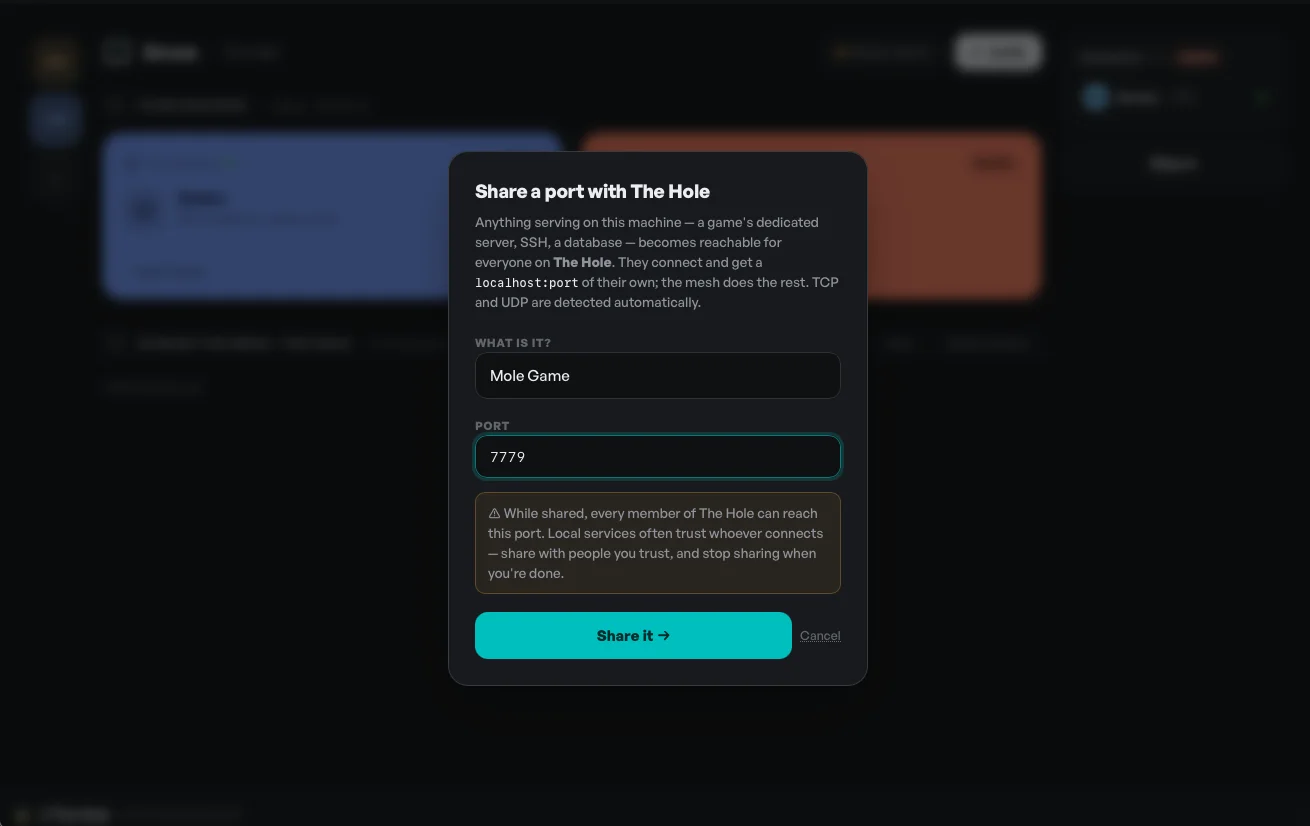
Share a port. A Minecraft server, SSH, a database, anything listening on this machine becomes a port on everyone else's, TCP or UDP detected on the way through. And end-to-end encrypted chat: a drawer along the bottom that stays open while you move between apps.
2026.06.10 — TWO DOORS
The spec had three modes. What shipped is two doors on every tile: Together, one shared session, or Solo, your own session on their backend. The same day the agent learned to hold many networks at once, a rail of them down the side, and got a desktop shell with itself as the sidecar.
2026.06.09 — BY NAME
The first real commit was the dispatch layer and the linter. Every app, upstream, and mesh-wide capability has a name, and the agent resolves it: local provider first, then whoever in the net announces it, with a hop header so a request cannot chase its own tail.
WHAT WAS DESIGNED AND NOT BUILT
The design said CRDTs. What shipped is last-write-wins per key, ordered by the host's agent, with three rules that both ends enforce. An unchanged value is dropped before it is sent and again when it arrives. You never hear your own writes back. And every twenty seconds the two sides compare notes anyway, because events cross in flight and leave a stable desync where each holds the other's value. It is not Figma. It is enough for a whiteboard and a garden, and the CRDT remains an addition, not a contradiction.
The design also said identity would be federated OIDC, because a net owner should never have to take Gruve's word for which human a node is. What shipped is no accounts. You are your keypair and the name you typed. The spec had already noted that an auth outage would lock every net at once. In hindsight that reads like the reason.
HONEST EDGES
Moderation is partial. Mute lives in the UI but is not bound to the node key, and there is no kick or ban, so anyone holding the invite can come back. A host has to be online to host, which is what hosting means here. And the no-central-server claim carries exactly one asterisk, the optional invite shortener, which sees a hash and a ciphertext and nothing else.